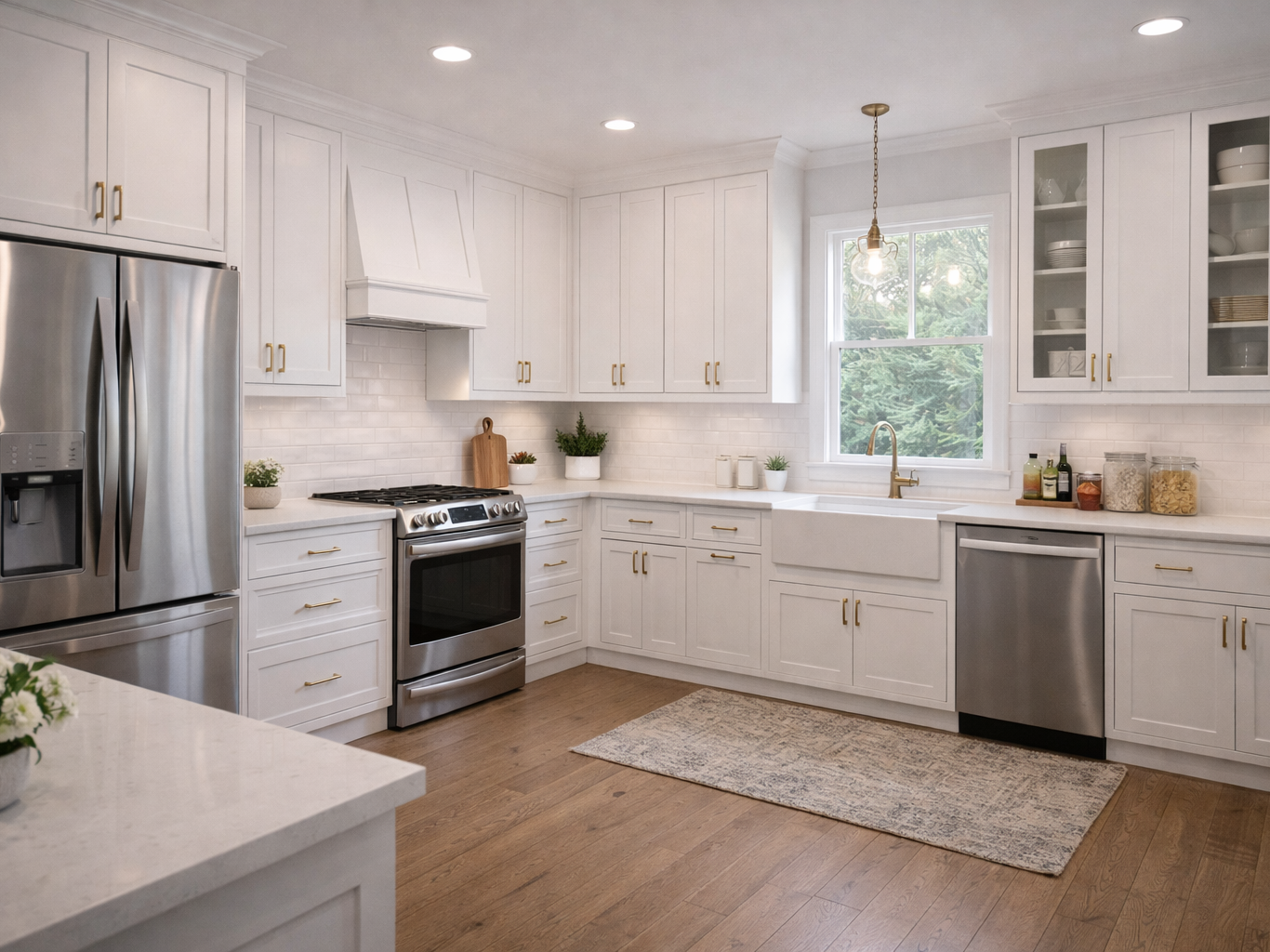
Cabinet installation looks simple in finished photos, but the work is full of small decisions that add up to a clean, professional result—or a frustrating one. Most cabinet problems homeowners notice (uneven gaps, awkward spacing, doors hitting each other) can be prevented with better planning and a quality install process.
This guide covers common cabinet installation mistakes and how to avoid them. If you’re planning cabinet work in the Greater Lexington, KY area, this is a helpful planning checklist to start with.
Quick takeaways
- Assuming walls and floors are perfect leads to uneven lines and gaps.
- Skipping clearance checks leads to door/drawer conflicts and appliance issues.
- Leaving hardware decisions late leads to rushed choices and inconsistent placement.
- Ignoring sequencing leads to rework with paint, flooring, and tile.
0) Start with what’s included (what is included?)
Many cabinet headaches start before install day because “install cabinets” can mean different levels of work:
- Are old cabinets being removed, or is the space already cleared?
- Are baseboards removed and reinstalled (or replaced)?
- Is wall repair and paint touch-up included after cabinets go in?
- Are fillers, end panels, and trim details included?
- Is hardware installation included, and do you already have hardware selected?
Clarifying what’s included keeps timelines and expectations smoother. If you want a planning baseline, start with: Cabinet installation.
One more common mistake: not planning for site protection. Cabinets are large, and deliveries and staging can scuff floors and walls if pathways are tight. If the home is occupied, plan where boxes will sit, what areas need floor protection, and how the space will stay usable during installation.
1) Not measuring the whole room
One wall measurement isn’t enough. Cabinet layouts depend on:
- Multiple wall lengths
- Window and door casing
- Ceiling height
- Fixed plumbing and electrical
Use a full-room measurement approach: Cabinet installation planning guide.
Additional measurement tips that prevent surprises:
- Measure ceiling height in more than one spot (it can vary).
- Measure diagonals on larger openings to understand if the room is out of square.
- Note anything that projects from the wall (vents, pipes, chases, baseboard heaters).
- Photograph the space with context (corners, doorways, and adjacent walls).
2) Ignoring level and plumb realities
Cabinets highlight imperfections. If floors are out of level or walls are out of plumb, cabinets can look uneven unless the install is planned to create straight reference lines.
Why this matters:
- Countertops visually “track” the cabinet line. If cabinets are not aligned, the whole space looks off.
- Door and drawer gaps are easier to notice when the cabinet line waves up and down.
- End panels and fillers can look awkward if the installer is forced to hide large out-of-plumb gaps at the last minute.
A good plan assumes real houses are imperfect and builds in the steps (and time) needed to create straight, intentional lines.
Ways uneven conditions show up in real installs:
- A cabinet run that looks straight up top but has a visible gap at the wall behind.
- Countertops that appear to “tilt” because the cabinet line isn’t consistent.
- End panels that flare away from the wall because the wall bows.
Questions worth asking early:
- How will out-of-level floors be handled (shim strategy and reference line)?
- How will out-of-plumb walls be handled (scribing fillers or other approach)?
- What is the finish expectation at end panels and wall transitions?
3) Skipping clearance checks
Common clearance problems:
- Refrigerator door conflicts
- Dishwasher door conflicts
- Corner door/drawer collisions
- Walkway pinch points around islands or peninsulas
Clearances should be confirmed before ordering or installing.
Practical clearance checks to do early:
- Open the appliance spec sheet and confirm required openings and door swing.
- Check that drawer pulls and door handles won’t collide in corners.
- Confirm that doors and drawers can open fully without hitting a wall, trim, or appliance handle.
If door replacement is also part of your plan, it can affect clearances and transitions: Door installation.
4) Underestimating finish details (fillers, panels, trim)
Finish details often include:
- Fillers at walls and corners
- End panels on exposed cabinet sides
- Crown molding or trim (if used)
These pieces make cabinets look built-in rather than “floating in a gap.”
Finish detail decisions that change the final look:
- Do you want a tight, scribed fit at walls (more custom look) or a wider filler (simpler)?
- Will there be exposed cabinet sides that need finished panels?
- Are you adding crown molding, light valances, or other trim elements?
These parts are not “extras” if you want a polished look. They are the details that make the installation feel intentional.
5) Not planning the backsplash and countertop timing
Cabinet installation often affects:
- Countertop measurement timing
- Backsplash edge planning
- Wall paint access behind cabinets
If tile backsplash is part of the plan, coordinating early prevents awkward cuts: Tile backsplash planning.
Sequencing tips that help:
- Plan drywall repair and paint prep before cabinets when walls are in rough shape.
- Plan backsplash edge details before cabinets are set if you want specific termination points.
- Confirm when countertops are measured and installed so you don’t block access or create rework.
6) Leaving hardware decisions to the last minute
Hardware affects:
- The final look
- Daily usability
- Drill hole patterns (hard to change later)
Even if you don’t order hardware early, having a placement plan reduces last-minute stress: Cabinet hardware placement guide.
If you’re unsure, a simple approach is to:
- Pick one finish family for all hardware in the space.
- Test placement on a sample door/drawer or with painter’s tape before drilling.
- Decide whether you want knobs, pulls, or a mix (and keep it consistent).
7) Poor sequencing with flooring and doors
Flooring height changes can affect:
- Toe-kick appearance
- Appliance clearances
- Door clearances
If vinyl or tile floors are being updated, plan finished heights and transitions: Vinyl flooring and Tile installation.
Additional sequencing detail:
- If new flooring changes the finished height, toe-kick lines can shift.
- Door clearances can change (especially interior doors that were already close to the floor).
- Transitions at doorways can become awkward if heights are not planned together.
8) Skipping the final adjustment and alignment phase
Cabinet installation isn’t finished when the boxes are on the wall. The final quality often depends on:
- Door hinge adjustments so doors align and close cleanly
- Drawer adjustments so gaps are consistent
- Confirming that cabinet lines look straight in the main sightline
This is where “close enough” becomes “finished.” If you’re planning the timeline, don’t assume hardware and adjustments are a 10-minute step.
9) FAQs
Can cabinets be installed on an uneven floor?
Yes, but it requires shimming and careful reference lines so the cabinets look level and consistent.
Do cabinets need wall repairs first?
Often, yes—especially if old cabinets were removed. Drywall repairs and paint planning keep the finished look clean: Drywall.
How do I keep a cabinet project from dragging out?
Make the key decisions early: layout, finish panels, hardware plan, backsplash plan, and paint plan.
What should I do before cabinets arrive?
Make sure the room is ready: clear access, protect floors, confirm measurements, and resolve any wall repair needs. Delivery staging space is often the hidden constraint.
Do cabinets go in before the backsplash?
In most projects, yes. Cabinets set the reference line for countertops, and backsplashes are typically installed after countertops are in. The key is planning edge details and sequencing so tile cuts and finish lines look intentional.
Can cabinet work be combined with other finish work?
Often, yes. Painting, drywall repair, tile backsplash, and flooring frequently overlap. Sequencing is the key to avoiding rework: Our process.
10) Quote checklist: what to send so planning is accurate
If you’re requesting an estimate for cabinet installation, the biggest time-saver is sending enough context to confirm layout and constraints:
- Supplier layout plan (if you have it)
- Room photos (wide shots of each wall and each corner)
- Ceiling height and any soffits or bulkheads
- Notes about floor level issues (if you’ve noticed them)
- Appliance list and specs (especially refrigerator and dishwasher)
- Hardware plan (or note that you want guidance)
- Timeline goal and whether the home is occupied or vacant
If you don’t have everything, that’s fine. The goal is to remove guesswork so the install plan matches the real space.
Next steps
- Cabinet service details: Cabinet installation
- Planning guide: Cabinet installation planning
- Start a quote request: Request a quote
Need help planning the next step?
Share photos and rough measurements to get a clear yes/no on fit and the right follow-up.